Jan 1996 – Aug 1998
CGSD — ARES Augmented Reality
Engineer
Augmented Reality
3D Visualization
Sensor Fusion
CAD
Data Visualization
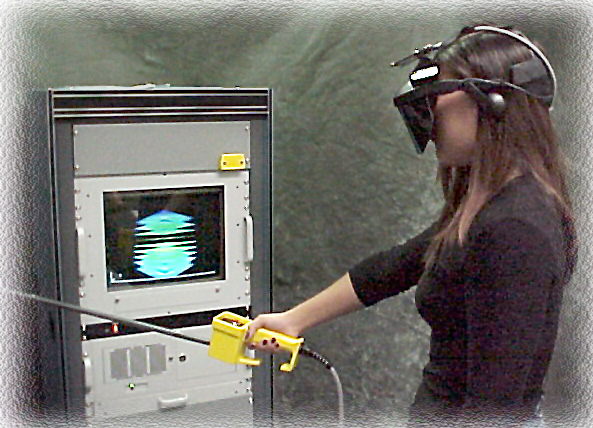
Engineer on the ARES (Augmented Reality System) — a see-through AR platform co-developed with Hokkaido Electric Power Company for scientific data visualization and CAD design review, years before modern AR headsets existed.
- Augmented Reality Pioneer — ARES superimposed computer-generated 3D imagery onto the real world using a see-through head-mounted display, enabling visualization of electromagnetic field data, CAD models, and abstract scientific data in physical space.
- Coordinate Frame Transforms — Managed a junior engineer to develop the mathematics for transforming data sets into a world coordinate system and creating the transform chain from the tracked headset to the world coordinate frame — producing perspectively correct visualizations for each viewer.
- Hybrid Tracking System — The system fused an optical tracker (ceiling-mounted infrared LEDs with stereo cameras) for position accuracy with an inertial tracker (gravity-sensing plus dual-axis rate gyro) for responsive orientation. Wrote exponential filtering software to estimate and remove gyro drift and hysteresis errors of ten degrees or more.
- Pre-Unity 3D Development — All 3D visualization was built using Sense8 WorldToolKit and Microsoft Visual C++ on Windows NT with dual-processor Pentium III hardware and a 3Dlabs GLX graphics accelerator — Unity had not yet been developed.
- Hokkaido Electric Power Collaboration — Co-developed with HEPCO R&D for visualizing measured electromagnetic fields, sound levels, and temperature data relative to real-world objects such as microwave ovens.
- CAD & Design Visualization — For design review, a 3D CAD model would hang in space visible in correct perspective to each team member, who could critique features by pointing with a tracked wand — offering advantages over projection-based systems like CAVE and virtual workbenches.
- Data Representation System — Implemented multiple mapping modes — brightness, Munsell color scale, transparency, size, and volume — to encode scalar data values onto 3D graphical primitives, with display modes including raw sampled data, interpolated points, contour lines, and textured transparent planes.
Photos